Patternmaker and the Tide

“The Patternmaker and the Tide” is a 2022 domestic fiction novel by English author Neil Mach. The novel combines dark comedy with memorable characters, demonstrating that kindness, love, and happiness can be discovered in surprising settings.
ISBN-10 : 1727311884
ISBN-13 : 978-1727311884
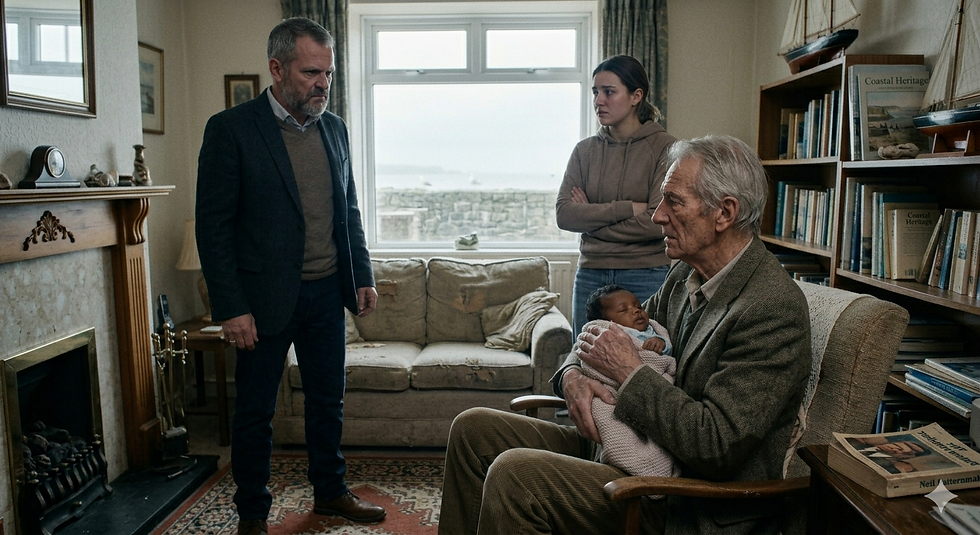
When a rigid, elderly retired patternmaker rescues a dark-skinned baby from an English beach, his orderly life is shattered by a cynical son, an uninvited houseguest, and a small town that boils with prejudice.

The Patternmaker and the Tide follows a retired, elderly gentleman living a rigidly structured life in a declining English seaside town. His quiet, predictable world is completely turned upside down when he discovers a living, dark-skinned baby washed up on the beach, and a mysterious young woman subsequently blarneys her way into his home to "help" care for the foundling.
Core Themes in The Patternmaker and The Tide
Disruption of Order vs. Chaos: The protagonist relies on precise and daily symmetrical routines (much like his former career as a patternmaker). The sudden arrival of the baby into his life and also the arrival of the young woman introduces beautiful, messy chaos that shatters his rigid balance.
Prejudice and Community Hostility: When the locals discover that his abandoned baby has dark skin, the town's underlying racial biases, xenophobia, and open prejudices are exposed, forcing the old man to see his neighbours in a new, harsher light.
Family Conflict and Scepticism: The novel explores generational divides and cynicism. The patternmaker's emotionless son aggressively opposes his father's soft-heartedness, accusing the young woman of being a gold-digger and the baby of being a pawn in a scam.
Living in a world he no longer recognizes, the old man grapples with a deep sense of detachment from society...
Isolation and Rediscovering Connection: Living in a world he no longer recognizes, the old man grapples with a deep sense of detachment from society. Caring for the vulnerable infant forces him to reconnect with his own dormant empathy and humanity.
Institutional Failure: As the old man tries to navigate what to do next, the book highlights the indifference and absence of authorities who seem entirely unconcerned with the child's welfare.
The Language of Symmetry and Disruption
Because the protagonist is a retired patternmaker —a trade reliant on exact measurements, precise geometry, and physical templates— Neil Mach purposefully mirrors this mindset in the early prose. The language of the novel begins as highly structured, orderly, and focused on the "symmetry of daily routine." The overall effect is a stylistic tug-of-war: the quiet, methodical prose of an aging craftsman trying to maintain order, while constantly being pushed-and-pulled by the ebbing tides of all the chaotic, vocal people around him who have forced their way into his steady life.
As the narrative progresses and after the protagonist has found the baby on the shoreline, the linguistic style becomes fragmented and chaotic. The earlier precise, rhythmic prose breaks down to reflect the old man's internal disorientation as his rigid, orderly life becomes evermore disrupted.
Character-Driven Vocabulary and "Blarney"
Mach relies heavily on colloquial British speech and regionally specific language to draw lines between his characters.
The Young Woman: Her dialogue is described as "blarney"—fluid, persuasive, and charmingly manipulative. Her language is lively and persistent, providing a stark contrast to the old man's internal landscape.
The Son: The dialogue of the protagonist’s son is cold, transactional, and suspicious. He uses accusatory, cynical terms, viewing the young woman as a "gold-digger" and the baby as a "pawn."
Contrast Between Internal Reflection and Social Friction
The narrative voice splits into two very different linguistic registers:
The Reflective and Melancholic: When focusing on the old man, the prose is soft, sensory, and deeply psychological. Neil Mach's prose captures a sense of dissociation and a creeping realization that the elderly man has lost his connection with the modern world.
The Blunt and Prejudiced: When the townspeople discover the foundling baby has dark skin, the language shifts aggressively. Mach uses sharp, unvarnished, and uncomfortable dialogue to expose the raw prejudices and vocal anger of the community.

Comparative titles:
King of Kings by Susan Hill
A Man Called Ove by Fredrik Backman
Silas Marner by George Eliot
Ebook:


Comments